
| Date | Version | Changes |
|---|---|---|
| 2021-11-18 | v1.0.0 | Adding examples of good and bad resource names. |
| 2025-10-17 | v1.1.0 | Changing the convention. |
The Azure Resource Naming tool will help you create a name that follows this convention.
1.1 Resource names MUST follow this format
{resource-type}-{project}-{component}-{environment}-{location}-{index}
1.2 Resource names MUST be in lowercase
1.3 Resource names SHOULD be in kebab case, unless prohibited by Azure resource naming restrictions.
1.4 Component part of resource name MAY be excluded when project only has one component.
1.5 Azure automatically created resources SHOULD NOT be renamed to match this naming convention.For Azure created resources, you should not make sure it conforms with this convention.
Following sections references individual parts of the resource name format.
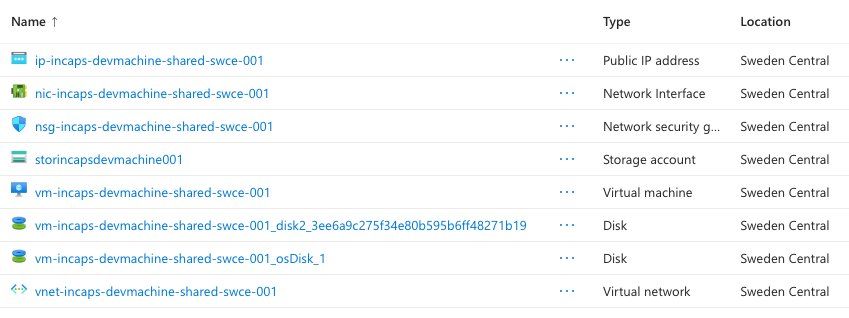
1 Resource Type
1.1 Official Microsoft resources MUST use abbreviation from recommended abbreviations for Azure resource types.
1.2 Custom resource type abbreviation MUST be used for non-Microsoft resources.
Examples
- rg – resource group
- vm – virtual machine
- nsg – network security group
2 Project
2.1 Project MUST be the name of the project or application.
2.2 Project MUST NOT include information that is redundant like company name, unless that is part of the project name.
2.3 Project SHOULD be abbreviated when exceeding 20 characters, but the abbreviation MUST be easy to understand without domain specific knowledge.
Examples
- intranet (good)
- volvo-intranet (bad, redundant company name)
- configurator (good)
- car-configuration-tool (bad, too long)
3 Component
3.1 Component MUST be included when project has several components.
3.2 Component SHOULD be no longer than 5 characters.
3.3 Component SHOULD be abbreviated with known abbreviations like web, api.
3.4 Component SHOULD not refer to an infrastructure resource.
Examples
- web (good, website)
- bi (good, business intelligence)
- db (bad, refers to an infrastructure resource)
- payment (bad, too long use psp instead which is a known abbreviation)
4 Environment
4.1 Environment MUST be specified in the resource name.
4.2 Environment SHOULD be dev, test, stage, prod or shared.
4.3 Custom environments MUST be added when base environments are not enough.
| Specifier | Environment |
|---|---|
| dev | Development |
| test | Test |
| stage | Staging |
| prod | Production |
| shared | Shared |
5 Location
5.1 Location must be specified in the resource name.
5.2 Location should be abbreviated into a 3-4 letter string.
Examples
- weu – west europe
- neu – north europe
- swce – sweden central
6 Index
Index is an increment to allow you release new configurations of the same resource without deleting the old one. This is useful when you want to make a transition without downtime, or if you need to run new and old configurations simultaneously.
6.1 Index must be specified in the resource name.
6.2 Index should be a three digit number, starting with 001
 Klabbet